
🐐
Goat Farming Calculator
Calculate profitability, feed requirements, and herd management for goat farming operations.
Calculate NowAdvanced Free AI Assistant for Agriculture and Livestock Management
Optimize your yak farming operations with precise calculations for feed, pasture, profitability, and herd management. This comprehensive tool helps both small-scale and commercial yak farming operations maximize efficiency.
Enter your yak farming details and click "Calculate" to see results
Get personalized recommendations for your yak farming operation
Based on typical yak farming data, you can expect 15-25% profit margins with proper management.
Yaks consume 2-3% of their body weight in dry matter daily during grazing season.
Diversifying products (meat, milk, wool) increases revenue stability in yak farming.
Get AI-powered insights based on your current calculator inputs
Yaks typically consume 2.5% of their body weight in dry matter daily.
This calculates how many yaks your pasture can sustainably support.
Meat production is estimated at 45% of live weight for slaughter yaks.
Given: 50 yaks, average weight 350kg, pasture quality "Good" (0.8 factor)
Daily Feed Requirement:
50 × 350 × 0.025 = 437.5 kg dry matter/day
Pasture Requirement:
50 × 1.5 × 0.8 = 60 acres needed
Annual Meat Production:
(50 × 0.3 slaughter rate) × (350 × 0.45 meat yield) = 2,362.5 kg
Key Insight: For sustainable yak husbandry, ensure adequate pasture and supplement feed during winter months. Proper yak husbandry management can yield substantial returns from meat, milk, and wool products.
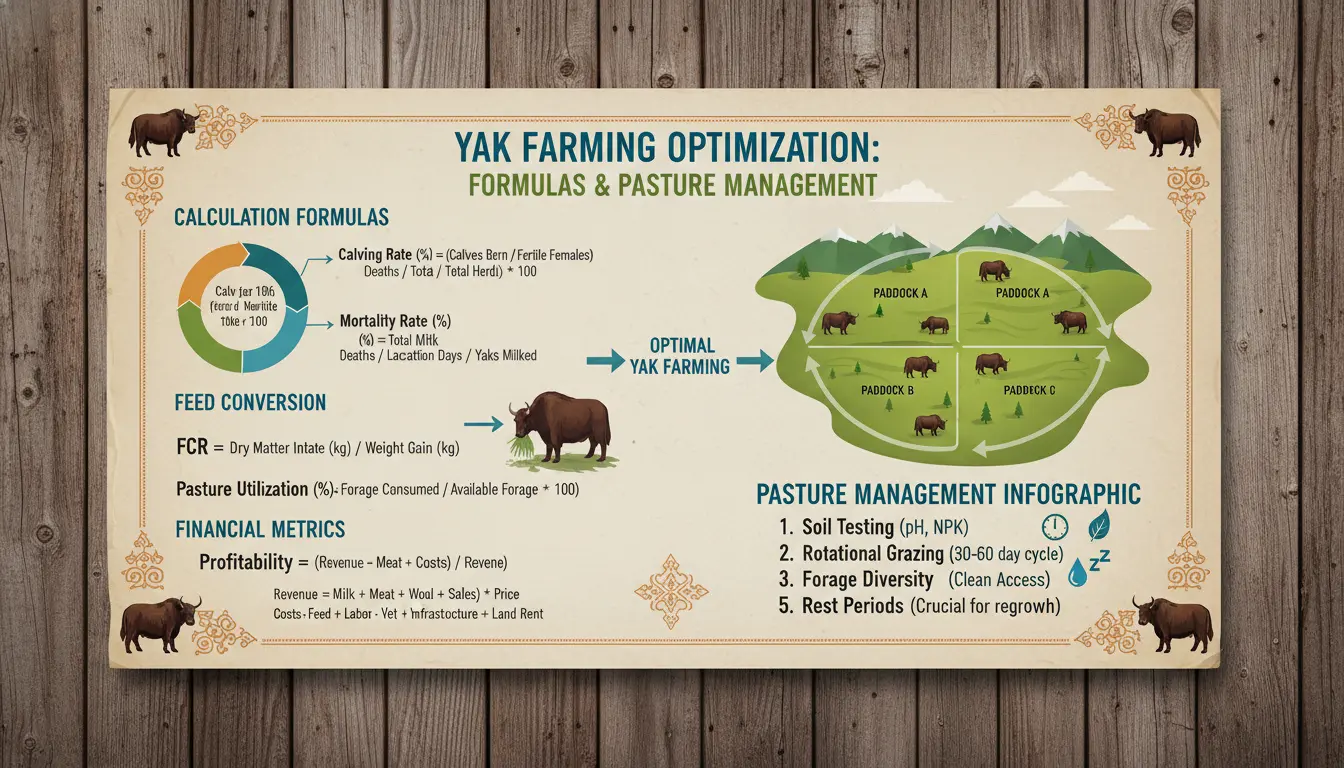
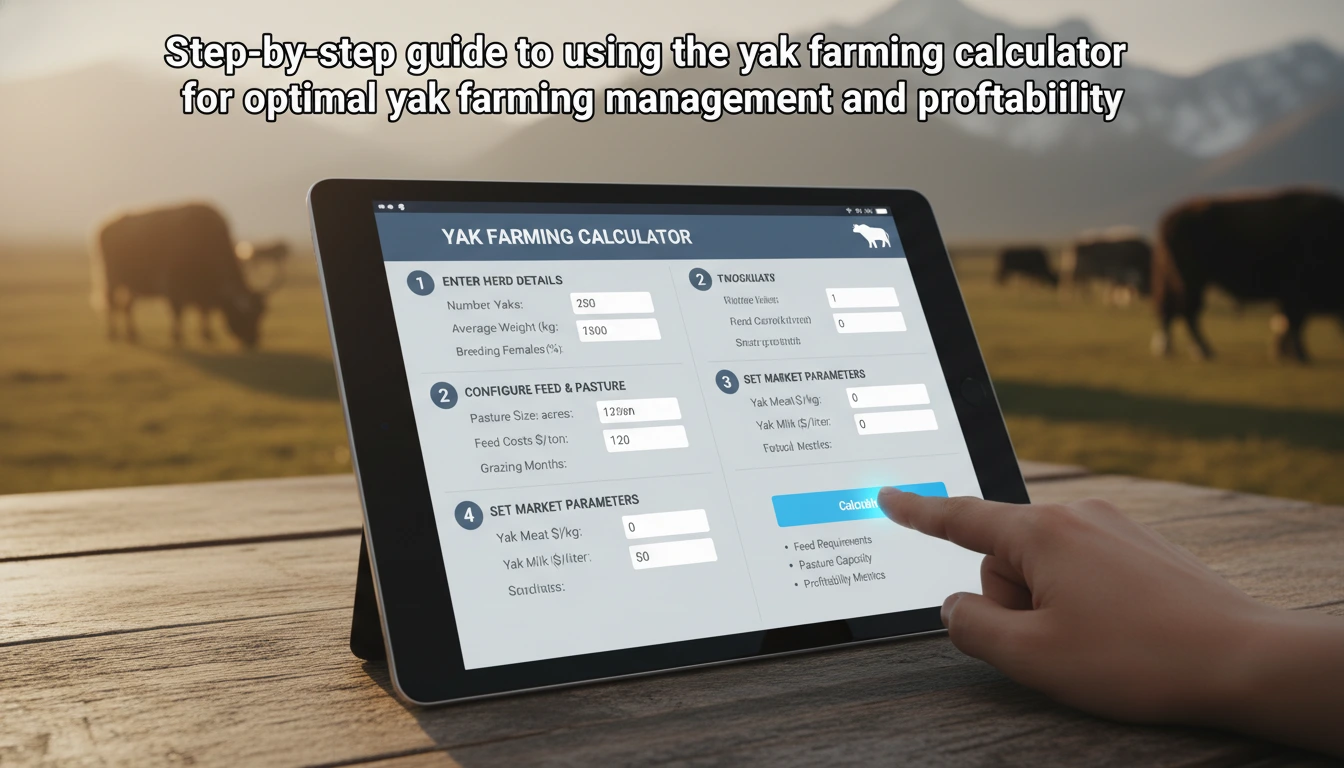
Start by inputting the number of yaks in your herd, their average weight, and the percentage of breeding females. This forms the foundation for all yak farming calculations.
Specify your pasture size, feed costs, and grazing months. The calculator will determine if your pasture can sustain your herd and calculate supplemental feed requirements for your yak farming operation.
Input current market prices for yak meat, milk, and wool. These values are crucial for accurate profitability analysis in yak farming.
Click "Calculate" to see detailed results including feed requirements, pasture capacity, revenue projections, and profitability metrics for your yak husbandry business.
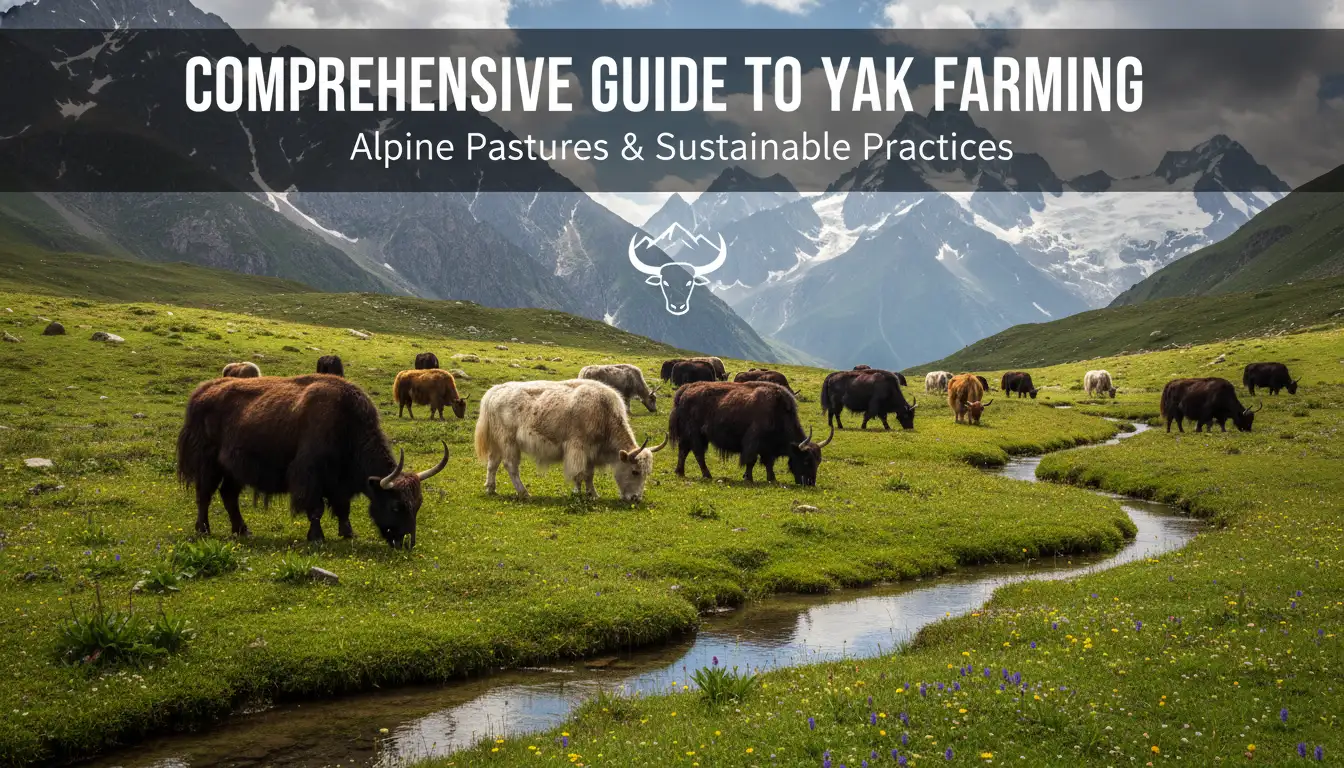
Yak farming represents a unique and increasingly profitable niche in livestock agriculture, combining traditional practices with modern management techniques for sustainable food and fiber production.
Yak husbandry involves the breeding and raising of yaks (Bos grunniens) primarily for their meat, milk, wool, and as draft animals. Indigenous to the Himalayan region, yaks are exceptionally adapted to high-altitude environments where other livestock struggle to thrive. Modern yak husbandry has evolved from traditional subsistence practices to include commercial operations that leverage the animal's unique characteristics for sustainable agriculture.
The significance of yak husbandry extends beyond economic considerations. Yaks play crucial ecological roles in fragile mountain ecosystems through their grazing patterns and manure distribution. Additionally, yak husbandry supports the livelihoods of millions of people in Central Asia's high-altitude regions, preserving cultural traditions while providing economic opportunities.
From a global perspective, yak Stock contributes to food security in regions with limited agricultural options and offers alternative protein sources with lower environmental impact compared to conventional livestock. The resilience of yaks to harsh conditions makes them valuable assets in the face of climate change, particularly for communities vulnerable to changing weather patterns.
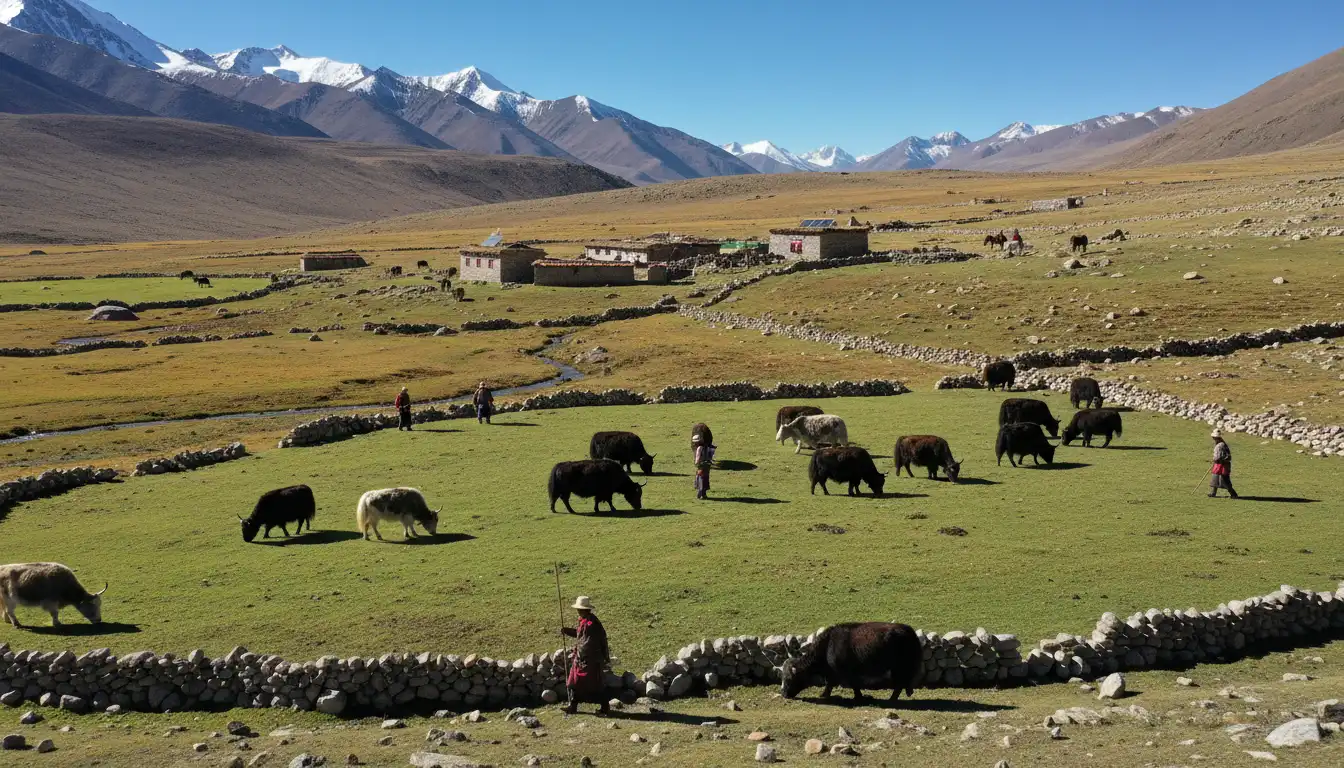
Sustainable yak farming practices in high-altitude regions
The advantages of yak husbandry are multifaceted, offering both economic and environmental benefits that make this form of livestock agriculture increasingly attractive:
Modern yak farming applications extend beyond traditional practices. Some innovative use cases include:
Effective yak husbandry requires specific knowledge and practices tailored to the unique characteristics of these animals. Here are essential considerations for establishing and maintaining a successful operation:
Proper herd management is fundamental to profitable yak husbandry. Key practices include:
Yaks are efficient grazers, but proper pasture management maximizes productivity in yak farming:
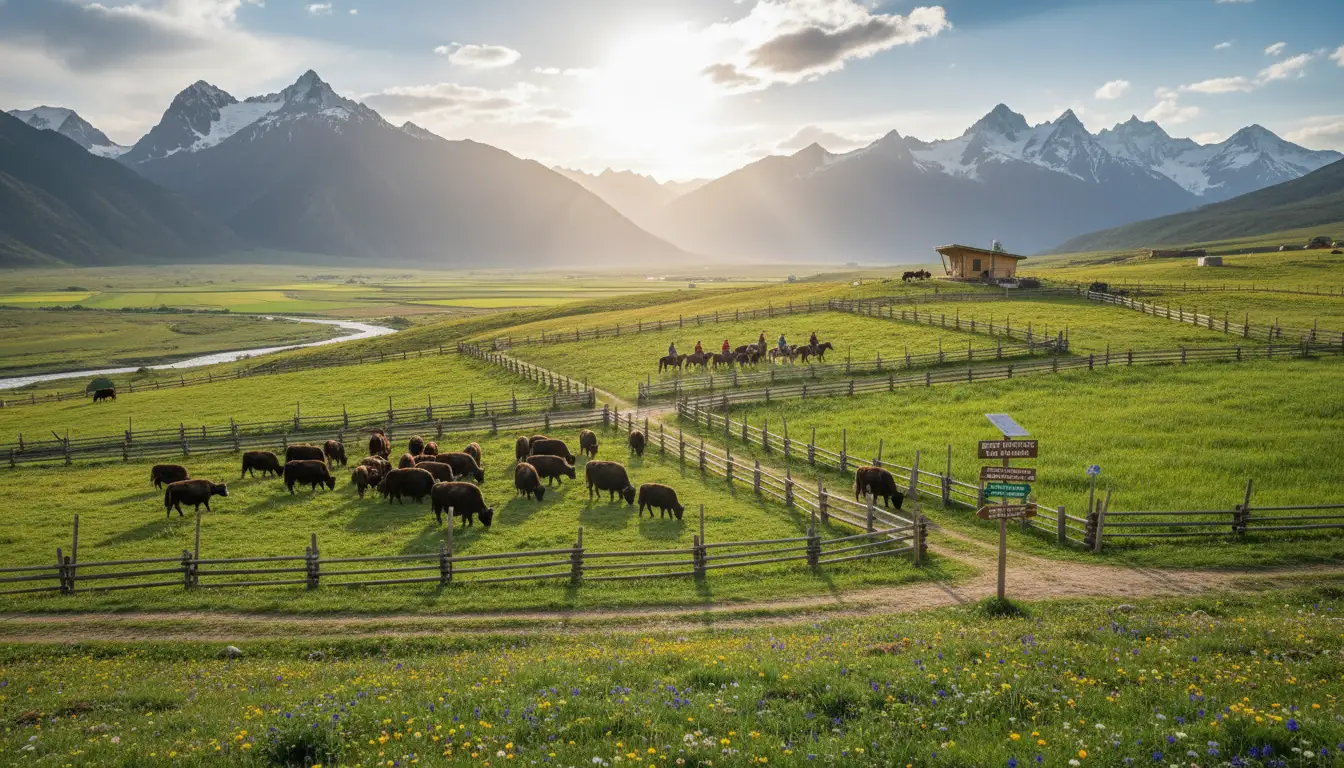
Rotational grazing systems for sustainable yak farming
Successful yak husbandry operations often incorporate value-added strategies:
Yak husbandry intersects with several related agricultural concepts that can enhance operations:
For those considering expanding their livestock operations, it's worth exploring complementary options like goat farming which can share similar infrastructure and marketing channels with yak farming. Similarly, cattle farming principles often apply to yaks with appropriate adjustments for their unique physiological adaptations.
Yak husbandry represents a sustainable and potentially profitable agricultural enterprise, particularly suited to marginal lands and changing climatic conditions. By combining traditional knowledge with modern management tools like our yak farming calculator, producers can optimize their operations for both economic and environmental outcomes. The future of yak farming lies in this integration of heritage practices with innovative approaches to meet contemporary challenges in sustainable agriculture.
Whether you're exploring yak farming as a new venture or seeking to optimize an existing operation, tools like our comprehensive calculator provide valuable insights for decision-making. By accurately modeling different scenarios, you can develop a yak husbandry business plan that balances productivity, sustainability, and profitability in this unique agricultural niche.