Permutation Calculator | Advanced Combinations Tool

Permutation Calculator

Number of total distinct items

Number of items to arrange/select

Calculation Results

Formula Used

P(n, r) = n! / (n - r)!

Result

60

Permutations

Calculation Details

P(5, 3) = 5! / (5-3)! = 120 / 2 = 60

Quick Actions

Calculation History

No calculation history yet

Free AI Assistant for Permutation Help

AI Assistant:

Hello! I can help you with permutation and combination calculations. Try asking me questions like:

  • What's the difference between permutations and combinations?
  • How do I calculate circular permutations?
  • Explain the formula for multiset permutations
  • Help me solve a permutation problem

Free AI Assistant powered by advanced algorithms

Quick Permutation Facts

Did You Know?

A standard deck of cards has 52! possible arrangements - that's approximately 8 × 10^67 permutations!

Quick Tip

Use the permutation calculator for password combinations, seating arrangements, and lottery probabilities.

Common Use

Permutations are essential in cryptography, game theory, and statistical analysis.

Permutation Formulas & Examples

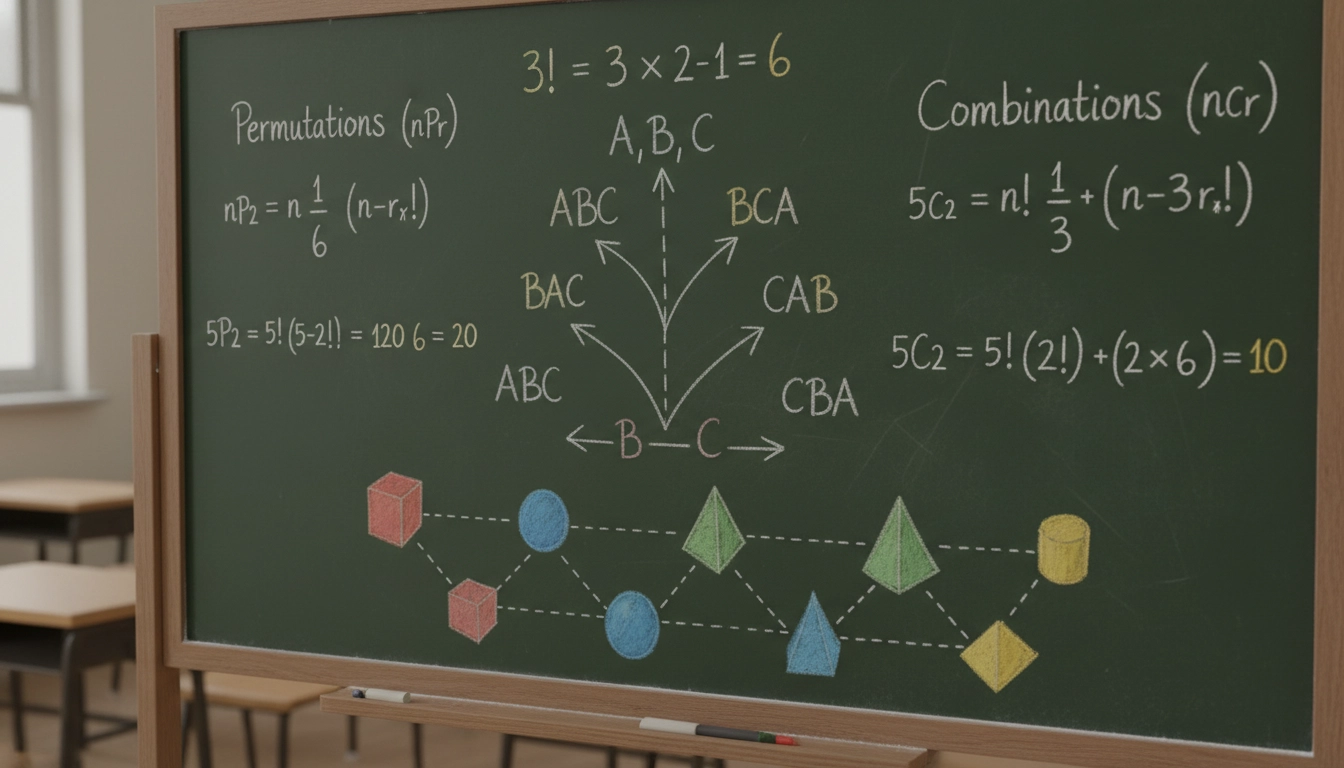
Permutation Calculator formulas showing arrangement patterns and mathematical notation

Visual representation of permutation calculations and arrangements

Standard Permutation

P(n, r) = n! / (n - r)!

Arrangement of r items from n distinct items where order matters.

Example:

P(5, 3) = 5! / (5-3)! = 120 / 2 = 60 arrangements

Combination

C(n, r) = n! / (r!(n - r)!)

Selection of r items from n distinct items where order doesn't matter.

Example:

C(5, 3) = 5! / (3!2!) = 120 / (6×2) = 10 combinations

Factorial

n! = n × (n-1) × ... × 1

Product of all positive integers less than or equal to n.

Example:

5! = 5 × 4 × 3 × 2 × 1 = 120

Permutation with Repetition

n^r

Arrangements where items can be used multiple times.

Example:

With 3 items taken 2 at a time: 3² = 9 arrangements

Circular Permutation

(n - 1)!

Arrangements of items in a circle where rotations are considered identical.

Example:

5 people around a table: (5-1)! = 4! = 24 arrangements

Multiset Permutation

n! / (n₁! × n₂! × ...)

Arrangements when some items are identical.

Example:

"MISSISSIPPI": 11! / (4!4!2!) = 34,650 arrangements

Advanced Permutation Formulas

Derangement (!n)

Permutations where no element appears in its original position.

!n = n! × Σ(-1)^k / k! for k=0 to n

Stirling Numbers

Ways to partition n items into k non-empty subsets.

S(n, k) = S(n-1, k-1) + k × S(n-1, k)

How to Use the Permutation Calculator

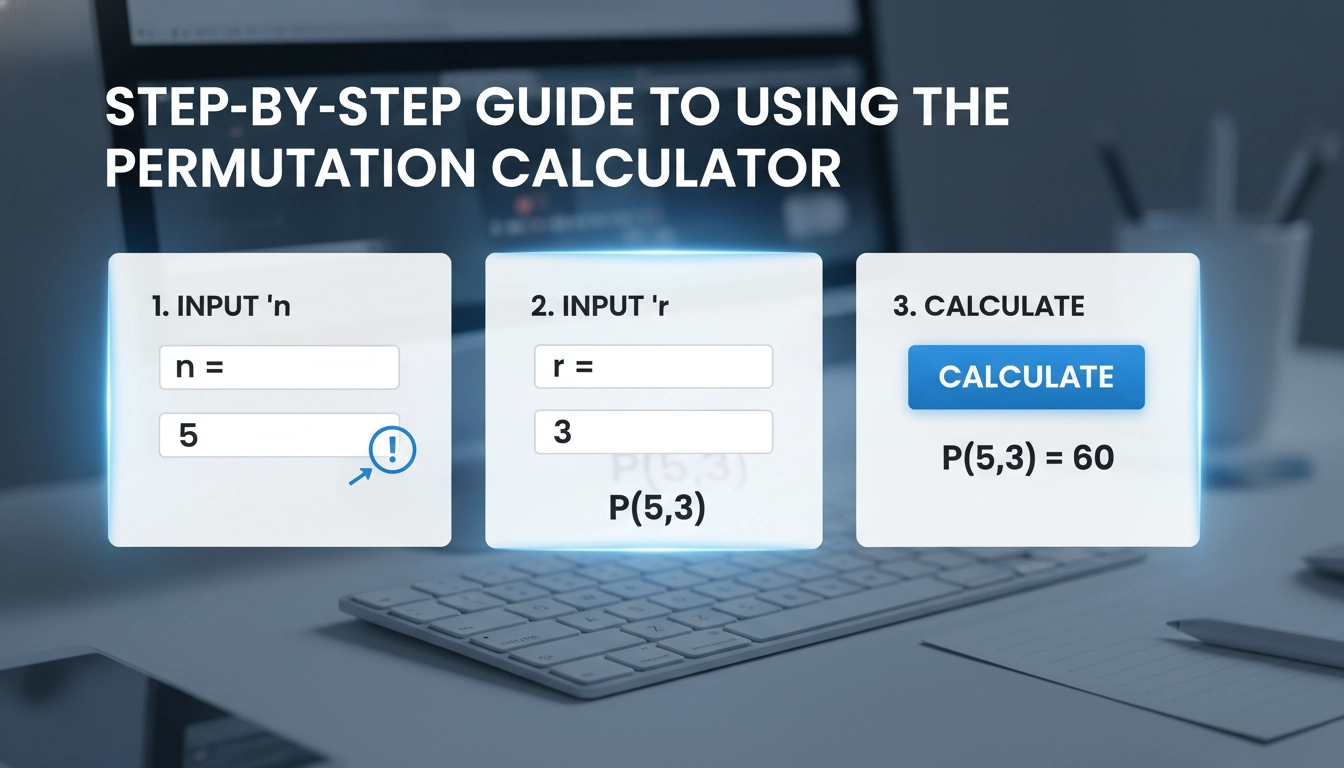
Permutation Calculator usage guide showing step-by-step instructions

Step-by-step guide to using the Permutation Calculator

  1. 1

    Select Calculation Type

    Choose from 10 different permutation calculations including standard permutations, combinations, factorial, circular permutations, and advanced options like derangements and Stirling numbers.

  2. 2

    Enter Values

    Input the required values (n = total items, r = selected items). For multiset permutations, enter the counts of identical items. The Permutation Calculator validates your inputs automatically.

  3. 3

    Set Advanced Options

    Configure additional parameters like precision level (standard, big integer, or scientific notation) and enable repetition if needed for your specific permutation problem.

  1. 4

    Calculate

    Click the "Calculate Permutations" button to compute your result. The Permutation Calculator displays the formula used and detailed calculation steps for verification.

  2. 5

    Review Results

    View your result, copy it to clipboard, share it, or save it to your calculation history. Use the "View Steps" button to see the complete mathematical derivation.

  3. 6

    Get AI Assistance

    Use the Free AI Assistant for additional help with permutation concepts or to explore related calculations and real-world applications.

Pro Tips for Using the Permutation Calculator

  • Use the "Load Example" button to see sample calculations for each type
  • For large numbers (n > 20), use "Big Integer" precision to avoid overflow
  • Save frequent calculations to your history for quick access
  • Use the AI Assistant for help with complex permutation problems
  • Check the formula section to understand the mathematics behind your calculation

Frequently Asked Questions

What is a Permutation Calculator?

A Permutation Calculator is a specialized mathematical tool that calculates the number of ways items can be arranged or ordered. It computes permutations (where order matters) and combinations (where order doesn't matter) for given sets of items. Our advanced Permutation Calculator handles 10 different calculation types including standard permutations, combinations, factorial, circular permutations, multiset permutations, derangements, Stirling numbers, Bell numbers, and Catalan numbers.

What's the difference between permutations and combinations?

Permutations consider the order of items (ABC is different from BAC), while combinations ignore order (ABC and BAC are considered the same combination). Our Permutation Calculator handles both calculations. For example, the permutation of 3 items from 5 is P(5,3) = 60 arrangements, while the combination is C(5,3) = 10 selections.

Can this Permutation Calculator handle large numbers?

Yes, our advanced Permutation Calculator uses efficient algorithms and Big Integer support to handle very large factorial calculations without causing browser performance issues. You can calculate permutations for values up to n=1000 or more using the "Big Integer" precision option.

Is the Permutation Calculator free to use?

Yes, this Permutation Calculator is completely free with no registration required. You can use it as often as needed for educational, professional, or personal calculations. All features including the AI Assistant, calculation history, and advanced permutation types are available at no cost.

What are some real-world applications of permutation calculations?

Permutation calculations have numerous real-world applications including password combinations, lottery probabilities, seating arrangements, tournament scheduling, cryptographic algorithms, genetic sequencing, quality control sampling, and statistical analysis. This Permutation Calculator helps solve these practical problems efficiently.

The Complete Guide to Permutation Calculators and Combinatorial Mathematics

A Permutation Calculator is an essential mathematical tool that computes the number of possible arrangements or selections of items from a set. This comprehensive guide explores the functionality, benefits, and applications of modern Permutation Calculator tools in mathematics, statistics, computer science, and real-world problem-solving.

What is a Permutation Calculator and Why It Matters

A Permutation Calculator is not just a simple tool for calculating factorials; it's a sophisticated application that implements various combinatorial formulas. Permutations refer to the arrangements of items where order matters, while combinations refer to selections where order doesn't matter. Understanding these concepts is crucial in probability theory, statistics, and many practical applications.

The significance of a Permutation Calculator extends across multiple disciplines. In education, it helps students grasp combinatorial concepts without getting bogged down in manual calculations. Statisticians use Permutation Calculator tools for probability calculations and experimental design. Computer scientists apply them in algorithm analysis and cryptography. Business analysts use permutation calculations for optimization problems, making the Permutation Calculator indispensable in both academic and professional settings.

Permutation Calculator showing mathematical formulas and arrangement patterns

Advanced Permutation Calculator tool for mathematical computations

Benefits and Use Cases of Permutation Calculators

Modern Permutation Calculator applications offer numerous benefits beyond basic arithmetic. Firstly, they provide precision that manual calculations cannot match, especially when working with large numbers. A high-quality Permutation Calculator can handle complex formulas like multiset permutations or derangements with ease.

Educational institutions benefit significantly from Permutation Calculator tools. Teachers can demonstrate combinatorial principles more effectively, while students gain hands-on experience with mathematical concepts. The Permutation Calculator also serves as a verification tool, allowing learners to check their manual calculations against accurate digital results.

In professional contexts, researchers use Permutation Calculator tools for statistical analysis, experimental design, and probability calculations. For example, calculating the number of possible experimental treatments or the probability of specific outcomes in clinical trials requires accurate permutation computations that a reliable Permutation Calculator can provide instantly.

Advanced Permutation Concepts

This Permutation Calculator implements several advanced permutation concepts:

  • Circular Permutations: Arrangements around a circle where rotations are considered identical
  • Multiset Permutations: Arrangements when some items are identical
  • Derangements: Permutations where no element appears in its original position
  • Stirling Numbers: Ways to partition items into non-empty subsets
  • Bell Numbers: Total number of partitions of a set
  • Catalan Numbers: Sequence of natural numbers with applications in combinatorial mathematics

According to the National Institute of Standards and Technology (NIST), combinatorial mathematics and permutation calculations are fundamental to statistical analysis and scientific research. Their guidelines emphasize the importance of accurate computational tools for reliable research outcomes.

For agricultural research and farming applications, permutation calculations help in experimental design for crop trials. Researchers at agricultural institutions like the USDA use permutation methods to design experiments that test multiple variables simultaneously, ensuring statistically valid results for improving crop yields and farming practices.

Real-World Applications

Permutation calculations have numerous practical applications:

  • Cryptography: Calculating possible encryption keys and password combinations
  • Genetics: Analyzing possible gene sequences and genetic combinations
  • Business: Optimizing schedules, routes, and resource allocations
  • Sports: Calculating tournament brackets and playoff scenarios
  • Quality Control: Designing sampling plans and testing protocols

For related probability calculations, explore our Probability Calculator for comprehensive statistical analysis. For geometric calculations, our Circumference Calculator provides accurate circle measurements. For precise scientific calculations, use our Significant Figure Calculator.

Using This Permutation Calculator Effectively

Start with standard permutations to understand basic arrangements. Then explore combinations to see how order affects outcomes. Try circular permutations for arrangements around a circle and multiset permutations for items with duplicates. Use the advanced options for derangements and Stirling numbers to explore more complex combinatorial concepts. This Permutation Calculator makes advanced mathematical computation accessible to everyone.

Tips and Best Practices

To maximize the effectiveness of a Permutation Calculator, consider these best practices:

  • Understand your problem: Determine whether order matters (permutation) or doesn't matter (combination)
  • Check for identical items: Use multiset permutations when some items are indistinguishable
  • Consider circular arrangements: Use circular permutations for arrangements around a circle or table
  • Use appropriate precision: Select standard, big integer, or scientific notation based on your needs
  • Verify with examples: Test the calculator with known examples to ensure understanding

Conclusion: The Future of Permutation Calculation Tools

The evolution of Permutation Calculator technology continues to enhance mathematical education and professional practice. Modern implementations combine computational accuracy with user-friendly interfaces, making advanced combinatorics accessible to everyone. As educational technology advances, we can expect Permutation Calculator tools to incorporate more sophisticated features like visualization of arrangements, interactive learning modules, and integration with statistical software.

Whether you're a student learning combinatorics, a teacher explaining mathematical concepts, or a professional requiring precise calculations, a reliable Permutation Calculator is an invaluable resource. By understanding both the capabilities and limitations of these tools, users can apply combinatorial mathematics more effectively in both theoretical and practical contexts.

The Permutation Calculator represents more than just a computational shortcut; it embodies the intersection of mathematical theory and practical application. As technology continues to evolve, these tools will undoubtedly become even more integral to mathematical education and professional practice, ensuring that combinatorial mathematics remains accessible and applicable in our increasingly data-driven world.

🎲

Probability Calculator

Calculate probabilities for events, distributions, and statistical outcomes with comprehensive analysis tools.

Calculate Probability

Circumference Calculator

Calculate the circumference of circles, arcs, and circular segments with precise mathematical formulas.

Calculate Circumference
🔢

Significant Figure Calculator

Calculate and round numbers to appropriate significant figures for scientific and engineering applications.

Calculate Sig Figs
`); stepsWindow.document.close(); }// Save current result function saveCurrentResult() { // In a real application, this would save to a database // For now, we'll just show a notification showNotification('Result saved to your account', 'success'); }// AI Assistant functionality async function askAIQuestion() { const question = aiQuestionInput.value.trim(); if (!question) { showNotification('Please enter a question', 'error'); return; } // Add user question to chat addChatMessage(question, 'user'); // Clear input aiQuestionInput.value = ''; // Show typing indicator const typingIndicator = addChatMessage('Thinking...', 'ai', true); // Simulate API call with timeout setTimeout(() => { // Remove typing indicator typingIndicator.remove(); // Get AI response const response = generateAIResponse(question); addChatMessage(response, 'ai'); // Scroll to bottom aiChatContainer.scrollTop = aiChatContainer.scrollHeight; }, 1000 + Math.random() * 1000); }// Generate AI response based on question function generateAIResponse(question) { const questionLower = question.toLowerCase(); // Predefined responses for common questions if (questionLower.includes('difference') && (questionLower.includes('permutation') || questionLower.includes('combination'))) { return "The key difference is that permutations consider order (ABC is different from BAC), while combinations ignore order (ABC and BAC are the same combination). Use permutations when order matters (like passwords or rankings), and combinations when it doesn't (like lottery numbers or committee selections)."; } else if (questionLower.includes('circular') && questionLower.includes('permutation')) { return "Circular permutations arrange items in a circle. Since rotations are identical, the formula is (n-1)! instead of n!. Example: 5 people around a table has (5-1)! = 24 arrangements, not 5! = 120."; } else if (questionLower.includes('multiset') || questionLower.includes('identical')) { return "Multiset permutations handle identical items. Formula: n! / (n₁! × n₂! × ...) where n₁, n₂ are counts of identical items. Example: 'MISSISSIPPI' has 11 letters with 4 I's, 4 S's, 2 P's: 11! / (4!4!2!) = 34,650 arrangements."; } else if (questionLower.includes('derangement')) { return "Derangements (!n) are permutations where no item is in its original position. Formula: !n = n! × Σ(-1)^k / k! for k=0 to n. Example: !4 = 9 derangements of 4 items."; } else if (questionLower.includes('stirling') || questionLower.includes('bell')) { return "Stirling numbers S(n,k) count ways to partition n items into k non-empty subsets. Bell numbers Bₙ = Σ S(n,k) give total partitions of n items. Both are important in combinatorics."; } else if (questionLower.includes('calculate') || questionLower.includes('solve')) { return "Use the Permutation Calculator above! Select your calculation type, enter values, and click Calculate. For specific problems, describe them and I'll help guide you through the solution."; } else if (questionLower.includes('real') && questionLower.includes('application')) { return "Permutations have many real applications: password combinations, tournament schedules, genetic sequences, experimental designs, quality control sampling, cryptographic keys, and statistical analysis."; } else { // Default response for other questions const defaultResponses = [ "I can help you with permutation and combination calculations. Try asking about specific formulas, differences between types, or real-world applications.", "For precise calculations, use the Permutation Calculator tool above. I can explain concepts and help you understand the mathematics behind permutations.", "I specialize in combinatorial mathematics. You can ask me about permutations vs combinations, circular arrangements, multiset permutations, or specific calculation methods." ]; return defaultResponses[Math.floor(Math.random() * defaultResponses.length)]; } }// Add message to AI chat function addChatMessage(message, sender, isTyping = false) { const messageDiv = document.createElement('div'); messageDiv.className = `p-3 rounded-lg max-w-[80%] smooth-transition ${isTyping ? 'opacity-70' : ''}`; if (sender === 'user') { messageDiv.classList.add('bg-gray-100', 'ml-auto'); messageDiv.innerHTML = `

You:

${message}

`; } else { messageDiv.classList.add('bg-purple-50'); messageDiv.innerHTML = `

AI Assistant:

${message}

`; } aiChatContainer.appendChild(messageDiv); // Scroll to bottom aiChatContainer.scrollTop = aiChatContainer.scrollHeight; return messageDiv; }// Show notification function showNotification(message, type = 'info') { // Remove existing notifications const existingNotifications = document.querySelectorAll('.notification'); existingNotifications.forEach(n => n.remove()); // Create notification const notification = document.createElement('div'); notification.className = `notification fixed top-4 right-4 p-4 rounded-lg shadow-lg z-50 smooth-transition ${type === 'success' ? 'bg-green-500' : type === 'error' ? 'bg-red-500' : 'bg-blue-500'} text-white`; notification.textContent = message; notification.setAttribute('role', 'alert'); document.body.appendChild(notification); // Auto-remove after 3 seconds setTimeout(() => { notification.classList.add('opacity-0'); setTimeout(() => notification.remove(), 300); }, 3000); }// Initialize when DOM is loaded document.addEventListener('DOMContentLoaded', () => { // Initialize calculator initCalculator(); // Set initial focus for accessibility calcType.focus(); // Load images with lazy loading const images = document.querySelectorAll('img[loading="lazy"]'); images.forEach(img => { // Add intersection observer for lazy loading if ('IntersectionObserver' in window) { const observer = new IntersectionObserver((entries) => { entries.forEach(entry => { if (entry.isIntersecting) { const img = entry.target; // In a real implementation, you would load the actual image here observer.unobserve(img); } }); }); observer.observe(img); } }); // Performance measurement if ('performance' in window) { setTimeout(() => { const navTiming = performance.getEntriesByType('navigation')[0]; if (navTiming) { console.log(`Permutation Calculator loaded in ${navTiming.domContentLoadedEventEnd.toFixed(2)}ms`); } }, 0); } });// Export functions to global scope for history buttons window.validateInputs = validateInputs; window.performCalculation = performCalculation;
Scroll to Top