

The Complete Guide to π Calculators and Mathematical Applications
A Pi Calculator is an essential mathematical tool that leverages the constant π (pi) to solve geometric problems involving circles, spheres, cylinders, and cones. This comprehensive guide explores the functionality, benefits, and applications of modern π Calculator tools in education, engineering, and scientific research.
What is a Pi Calculator and Why It Matters
A π Calculator is not just a simple tool for multiplying by 3.14; it's a sophisticated application that implements various mathematical formulas involving π. The mathematical constant π represents the ratio of a circle's circumference to its diameter, approximately equal to 3.14159. However, π is an irrational number with infinite decimal places, making precise calculations challenging without proper tools.
The significance of a π Calculator extends across multiple disciplines. In education, it helps students understand geometric concepts without getting bogged down in manual calculations. Engineers use π Calculator tools for designing circular components, while scientists apply them in physics experiments involving circular motion or wave functions. Architects rely on accurate π calculations when designing curved structures, making the π Calculator indispensable in both academic and professional settings.
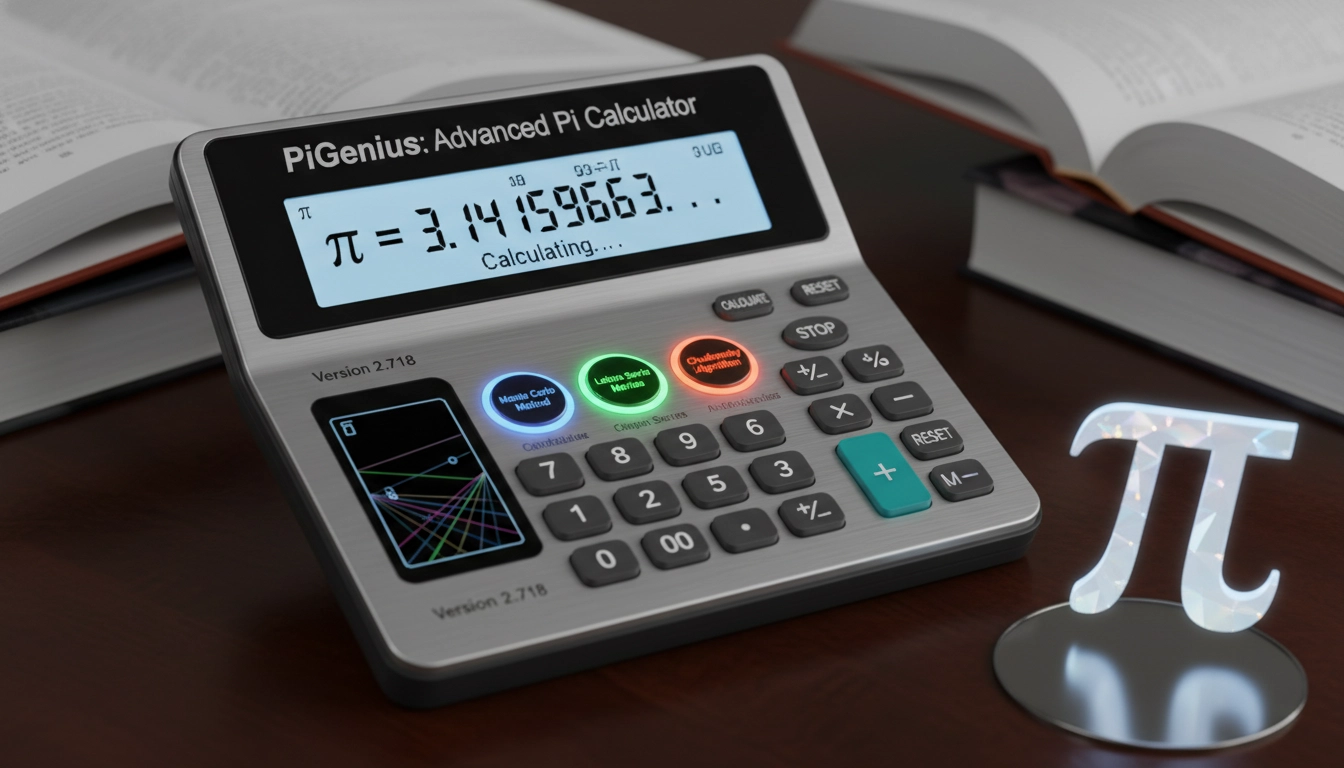
Geometric visualizations using the π Calculator for complex calculations
Benefits and Use Cases of π Calculators
Modern Pi Calculator applications offer numerous benefits beyond basic arithmetic. Firstly, they provide precision that manual calculations cannot match, especially when working with π to multiple decimal places. A high-quality Pi Calculator can handle complex formulas like sphere volume (V = 4/3πr³) or cylinder surface area (A = 2πrh + 2πr²) with ease.
Educational institutions benefit significantly from Pi Calculator tools. Teachers can demonstrate geometric principles more effectively, while students gain hands-on experience with mathematical constants. The Pi Calculator also serves as a verification tool, allowing learners to check their manual calculations against accurate digital results.
In professional contexts, engineers use Pi Calculator tools for precise measurements in mechanical design, civil engineering projects, and manufacturing. For example, calculating the material needed for circular pipes or the capacity of spherical tanks requires accurate π computations that a reliable Pi Calculator can provide instantly.
Advanced π Calculation Methods
This Pi Calculator implements five distinct methods for calculating π, each with unique characteristics:
- Monte Carlo Method: Uses probabilistic simulation with random points to estimate π
- Leibniz Formula: Implements the infinite series discovered by Gottfried Wilhelm Leibniz
- Nilakantha Series: Faster converging series discovered by Indian mathematician Nilakantha Somayaji
- Archimedes Method: Geometric approach using polygons to approximate circles
- Chudnovsky Algorithm: Ultra-fast algorithm used for record-breaking π calculations
Each method in this Pi Calculator offers different trade-offs between accuracy, speed, and computational complexity. The compare feature allows users to evaluate all methods simultaneously to understand their relative performance.
Real-World Applications and Industry Standards
Accurate π calculations are essential in numerous industries. According to the National Institute of Standards and Technology (NIST), precise mathematical constants are fundamental to scientific measurement and technological advancement. Their research underscores the importance of accurate calculation tools in both education and industry.
For comprehensive understanding of π's mathematical properties, the Wikipedia page on π provides extensive historical context and mathematical details. Additionally, the Pi Day website offers educational resources and celebrates the mathematical constant annually on March 14th (3/14).
For deeper mathematical analysis, Wolfram MathWorld's π page provides detailed formulas, properties, and computational methods used by mathematicians and scientists worldwide.
Using This Pi Calculator Effectively
Start with the Monte Carlo method with 1,000 points to see probabilistic computation. Then try the Leibniz formula with 10,000 terms to experience slow convergence. Compare with the Nilakantha series (100 terms) and Chudnovsky algorithm (just 1-2 terms) to see dramatic differences in convergence rates. Use the compare feature to run all methods simultaneously and analyze their performance characteristics. This Pi Calculator makes advanced mathematical computation accessible to everyone.

Advanced Pi Calculator tool with multiple calculation methods
Related Mathematical Concepts and Calculators
Understanding π extends beyond circle calculations. The constant appears in numerous mathematical contexts, including trigonometry, calculus, and complex analysis. Advanced Pi Calculator tools often incorporate related functions like calculating sector areas or arc lengths, which require angular measurements alongside radius values.
For related geometric calculations, explore our Distance Between Two Points Calculator for coordinate geometry problems. Similarly, our Slope Calculator helps with linear equations and calculus applications. For midpoint calculations in geometry, use our Midpoint Calculator.
These integrated approaches demonstrate the interconnectedness of mathematical concepts and the utility of specialized calculation tools. This Pi Calculator provides a comprehensive toolkit for both basic and advanced mathematical computations involving π.
Conclusion: The Future of π Calculation Tools
The evolution of Pi Calculator technology continues to enhance mathematical education and professional practice. Modern implementations combine computational accuracy with user-friendly interfaces, making advanced geometry accessible to everyone. As educational technology advances, we can expect Pi Calculator tools to incorporate more sophisticated features like 3D visualization, interactive learning modules, and integration with other mathematical software.
Whether you're a student learning geometry, a teacher explaining mathematical concepts, or a professional requiring precise calculations, a reliable Pi Calculator is an invaluable resource. By understanding both the capabilities and limitations of these tools, users can apply mathematical constants like π more effectively in both theoretical and practical contexts.
The Pi Calculator represents more than just a computational shortcut; it embodies the intersection of mathematical theory and practical application. As technology continues to evolve, these tools will undoubtedly become even more integral to mathematical education and professional practice, ensuring that the ancient constant π remains relevant in our increasingly digital world.