We've all had that moment at the checkout counter: the price tag says one thing, but the total comes out higher. That extra chunk is the consumption tax, and understanding it is vital for anyone shopping—or doing business—across borders. Here is a breakdown of how these taxes work, where they came from, and how to handle them today.
What Exactly is Sales Tax?
Think of sales tax as a fee for being the end consumer. It's a consumption tax paid to the government, but unlike income tax, it doesn't come directly out of your paycheck. Instead, it's an indirect tax; the shopkeeper collects it from you and passes it along to the state.
The key rule here is that the tax targets the final user. If a business buys wood to build a chair they plan to sell, they usually don't pay tax on that wood. They present a resale certificate to the seller to keep the transaction tax-free. The system is designed to tax the consumption of the product, not its creation.
The Different Flavors of Consumption Tax
While the concept is simple, the implementation varies:
- Retail Sales Tax: This is the standard in the U.S. It hits the consumer once, right at the final register.
- Value-Added Tax (VAT): Used by over 160 countries, this tax is collected little by little at every stage of production and distribution.
- Goods and Services Tax (GST): Basically a synonym for VAT. You'll see this term used in Canada, India, and Australia.
- Excise Tax: These are the specific taxes on "sin" items or fuel—like the per-gallon tax on gasoline or the tax on a pack of cigarettes.
- Use Tax: This is the government's safety net for online or out-of-state purchases where sales tax wasn't collected originally.
Running the Numbers
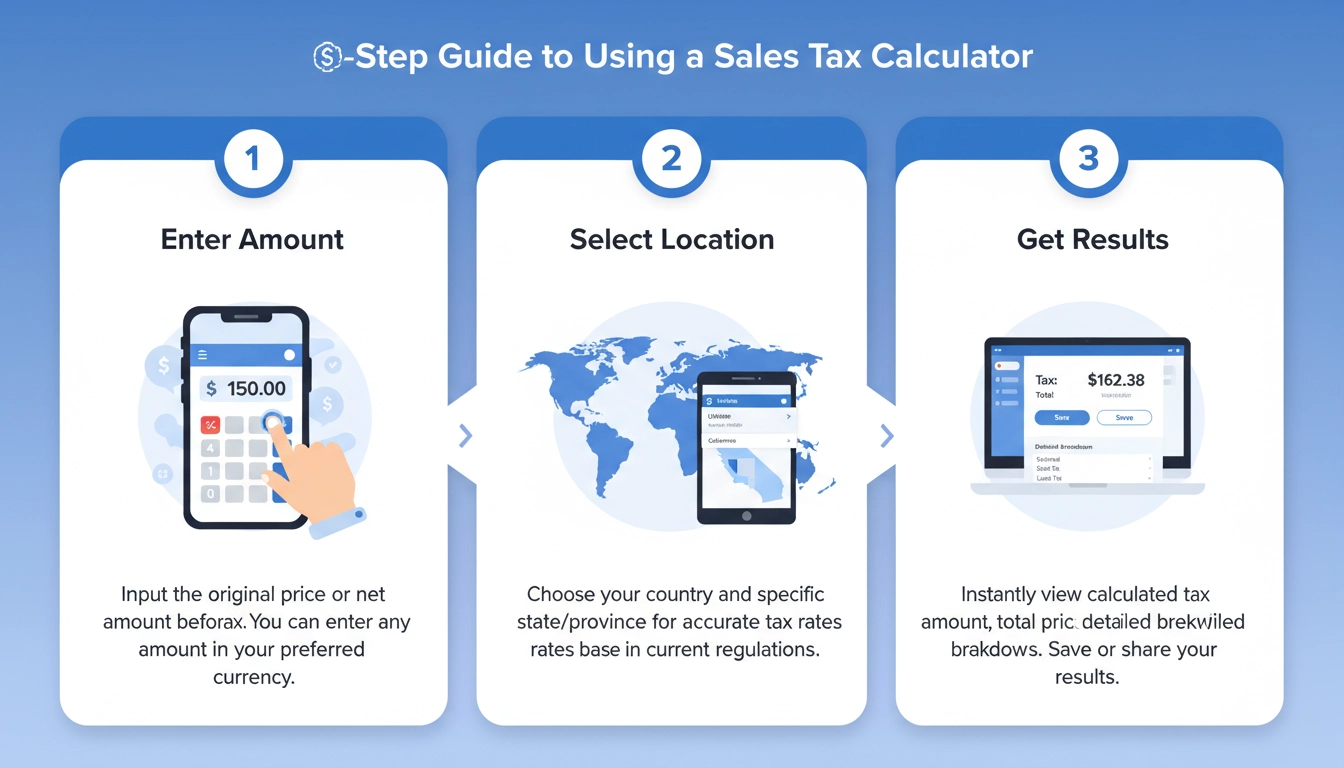
You don't need an accounting degree to figure out what you owe. If you know the price and the tax rate, the math is simple:
Price Before Tax × (Tax Rate ÷ 100) = Tax Amount
Let's say you're buying a $70 coffee maker in a spot with a 6.5% tax rate.
- Turn the percentage into a decimal (0.065).
- Multiply $70 by 0.065 to get $4.55.
- Your total at the register is $74.55.
Need to work backward from a total receipt? Just divide the total price by 1 plus the tax rate decimal.
Global Rates: A Tale of Two Systems
Trying to keep a master list of every rate worldwide is a losing battle—they change too fast. However, there is a clear divide in how countries handle this. The U.S. is the odd one out with its local retail sales tax. Almost everyone else uses a VAT system.
- VAT Worldwide: Most OECD nations (excluding the U.S.) use VAT. European rates can be steep; Hungary tops the charts at 27%, while Norway and Sweden sit at 25%. The global average hovers around 15%.
- The U.S. Patchwork: The United States doesn't have a federal sales tax. Instead, it's a chaotic mix of state and local rules. Five states (like Oregon and Delaware) charge 0%. Meanwhile, places like Tennessee or Chicago combine state, county, and city taxes to push the total rate over 10%.
VAT vs. GST: What's the Difference?
Really, not much. VAT is a multi-stage tax. Every business in the supply chain pays tax on what they buy and charges tax on what they sell, eventually sending the difference to the government. It's a self-policing loop that makes evasion harder. GST operates on the exact same principle; it's just the preferred terminology in countries like Singapore and Canada.
Can You Deduct Sales Tax?
It depends on who you are.
- For U.S. Individuals: You have a choice at tax time. You can deduct state income tax or state sales tax from your federal return—not both. This is usually only worth it if you live in a state with no income tax or if you made massive purchases that year (like a boat or materials to build a home).
- For Businesses: In VAT countries, companies generally reclaim the VAT they pay on business expenses. In the U.S., businesses use exemption certificates to avoid paying sales tax on inventory they intend to resell.
A Brief History of Taxing Stuff
This isn't a modern invention. Ancient Egyptians paid tax on cooking oil 4,000 years ago. Julius Caesar introduced a 1% sales tax across the Roman Empire (which Augustus later bumped to 4%).
The modern era split into two paths in the 20th century. France pioneered the VAT in 1954, which became the global standard. The U.S., however, took a different road during the Great Depression. Desperate for revenue, states like Mississippi began introducing sales taxes in the 1930s, leading to the decentralized system used today.
Looking Ahead: Compliance and Trends
The rules are constantly trying to catch up with technology. We are seeing a major push to tax digital goods—think software, streaming, and AI services.
Also, the days of avoiding tax because you don't have a physical store in a state are over. With "economic nexus" laws, if you sell enough into a region, you owe them tax, regardless of where your office is. For businesses, staying compliant now often means relying on specialized software to handle the complexity.
Key Takeaway
Whether you're a business owner, accountant, or consumer, using a reliable Sales Tax Calculator ensures accurate financial calculations, regulatory compliance, and informed decision-making. Our free AI-powered tool provides instant, precise calculations for any global location with user-friendly features that simplify complex tax scenarios.